


Remote UHF electronic label reader ZJ903-9DBI
Model: ZJ903-9DBI
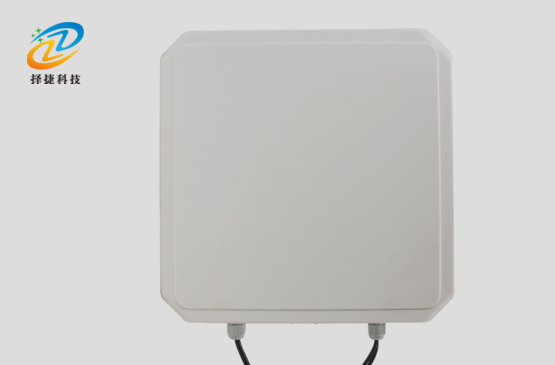
Product Overview
• The product has multi-negotiated, fast read rate and waterproof appearance design that meets stringent work environment requirements;
• Full support for electronic labels that are consistent with ISO-18000-6C (EPC G2);
◆ Supports multiple communication interfaces, including USB, RS232, and Wiegand 26/34.
• A 30 dbm output power adjustable to support multiple working modes such as timing, master-driven mode, trigger mode, etc.;
• Application appropriate in the areas of door-to-door prohibition, automatic non-stop charges, personnel door-to-door management, logistics monitoring and automated production management.
Specifications
• Working frequency: standard configuration ISM 902-928 MHz or ISM 865-868 MHz optional, customizing other frequency bands
• Antenna gain: internal round polarized antenna, gain 9dBi
• Protocol: ISO18000-6C (EPC G2)
• Development package: provision of SDK development kits and C#, VC, VB, Java, Delphi development routine
• Software: the provision of testing for DMO and automatic writing cards, reading cards for DMOs to facilitate client issuance cards and writing cards
• Output power: 0-30 dBm, software adjustable
◆ Communication interfaces: Type N: Wiegand 26/34, RS232/RS485, USB; Type E: Wiegand 26/34, RS232/RS485, TCP, USB.
Zoom Input interface: 1-Tracker input
• Read card mode: timed autoread cards and external trigger control read cards, set by software
◆ Read card speed: is set by software and averages less than 6 ms per 64bits per single card
• Reading distance: 0-8m (high power 0-10m) (reading distance associated with labels and field environment)
• Working temperature: -40°C ~ + 65°C
• Storage temperature: -45°C ~ +95°C
• Power requirement: DC12V, 3A
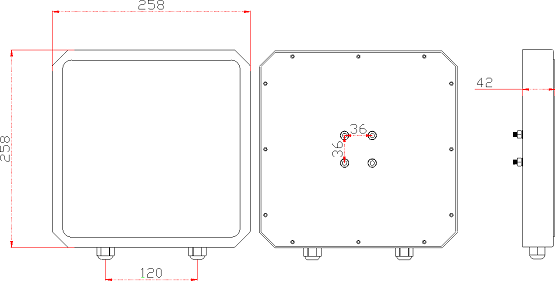
◆ Dimensions: 257 mm x 257 mm x 42 mm
◆ Weight: 1.45 Kg (with 2.45 kg packaged)
Additional Specifications
| Overall Dimensions | 257×257×42mm |
|---|---|
| Weight | 1.45 Kg (2.45 kg with packaging) |
| Operating Frequency | The standard configuration ISM 902-928 MHz or ISM 865-868MHz is optional and customises other frequency bands |
| Power requirements | DC12V,3A |
| Operating Temperature | -40℃~+65℃<... |
Structure size of the reader
Unit: mm
Reader Use
• Be used for the identification of items and data collection, taking advantage of their good characteristics, and be widely used, in particular in the following areas:
• Transport management: road, rail and container transport management;
• Motor vehicle management: the monitoring and management of motor vehicles in various sectors, including public security, transport, etc.;
• Road bridge charges: as the product has the ability to read label data at a long distance and at high speed, it can be done without parking;
• Customs clearance management: customs clearance, goods transferred and vehicle management;
• Warehouse logistics management: commodity movement and storage management, as well as the movement of mail, parcels, air luggage, etc.;
• Garage management: automation of administration and fees;
• Gate-ban management: including the control of access to vehicles and persons;
Process processes: Control of parts and components throughout the production process.
Reader's Main Functions
• Wake up labels: Only a woken label can communicate with the reader, prevent interference with other tags outside the system and ensure reliable and accurate information exchange between the reader and the system label.
• Read label data: not only can you read the ID number of the label, but also the data from the specified label storage area; not only can you read single labels and multiple tags within the antenna wave.
• Write label data: You can write to the specified label storage area.
◆ Connects directly to controllers with a standard Wiegand 26/34 interface. No development is required.
• Data communication and exchange through a standard communications interface linked to controllers or PC machines; and the provision of an SDK development package for further user development applications.
Use of caution
◆ ZJ903-series readers are usually connected to computers through RS232 data interfaces, and data exchange. Since ZJ903-series readers can only read and write electronic labels after receiving control orders from the controller, we will provide the customer with a SDK development package that allows users to do applications.
• The working temperature of the reader is: -40°C ~ 65°C. Therefore, when using this reader in cold areas and seasons, care should be taken to pre-heat it 15 minutes before the reader is officially used to ensure that the reader is running properly.
◆ It is recommended that, during the test, no object should be shielded at least 30 metres in front of the reader; when holding the card, please point your finger to the edge of the card and, because this antenna is horizontally polarized, the card should be spread across the reader to ensure that it reads.
• Wigen communications interfaces are required to connect to the GND surface.
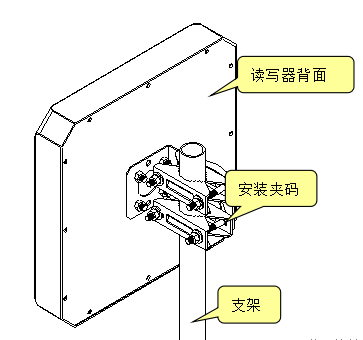
• Installation of a height above 1.8M, with a vertical bar 40-60CM diameter.
Installation Chart
♪ Hold the pole 40-60 mm in diameter
Reader working methods and connection instructions
Link description for the reader
• Red: DC+ (7-12V)
◆ Black: GND
• Green: RX
◆ White: TX
• Grey: WG-D1
◆ Purple: WG-D0
Tag Operations
• EPC GEN2(ISO18000-6C) label
• Initialization of single labels: 96 bits for the definition of the length of the label.
◆ Single-tag write: Writes to the tag's EPC. Each operation can write to one or more addresses, in units of 1 address.
◆ Single label lock: Locks the EPC. When locked, the EPC will not be able to rewrite the label.
• Single label destruction: destroy the label. Once destroyed, the label will no longer be used.
Modus operandi
◆ The main method of working (COMMAND): Under this mode of work, the reader works under the control of the PC or other controller. The reader and the controller can communicate through RS232, RS485, or one of the THINE interfaces. This way of working supports all the functions provided by the secondary development package.
• Timed working method (TIMING READ): Readers automatically read cards with a certain periodic (configurable) period, and the data read is exported by the specified message. This way the label is read-only.
◆ Trigger Method of Work (TRIGER READ): When you enter low electrical level on the trigger input port, the reader begins to read a periodic card and automatically closes after a certain period of time.
ID-by-Idem.
◆ The id-neighborship is designed to reduce the redundancy of the reader's upload data. When this feature is selected, when the reader reads the same label number repeatedly, it will only be uploaded over a set of times. A neighbouring class can select a valid time, i.e. if the two reading cards in the adjacent period are not spent longer than the time, they will not be judged by each other. Users should choose between specific needs.
Reader Configuration
The company provides the DMO software program to configure working parameters for readers. The parameter configuration interface is shown in the following graph:
Installation of a reader
Installation of a reader
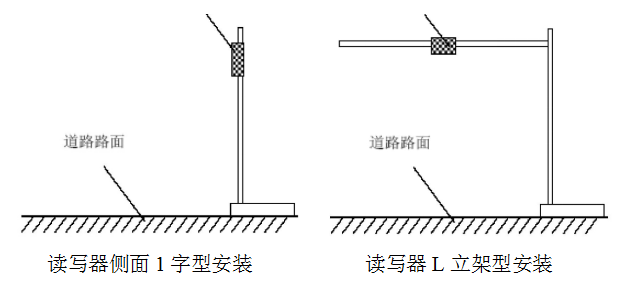
◆ The two types of installation for the reading and writing machine stand are: "Signer 1 font installation" and "L frame installation" are shown in the figure below: The installation can be selected according to application needs and actual on-site, usually with a close side view of reading and writing, but with a simple set; the top-loading is far away from reading and writing, but the installation is complex.
Fixed and high-level adjustment of the reader
◆ When a 1-word frame is mounted, you are required to install ZJ903-9DBI readers 40-60mm in diameter and 2.2m in length, with stainless steel materials larger than 1.2 mm wall thickness. The reader will be fixed at the top of the pole using the self-reinforcing device prepared for ZJ903-9DBI readers in their packaging box. The ZJ903-9DBI reading and writing centre is adjusted to the height of the level of the driveway, generally around 2.0 m (1.8~2.2m), depending on the type of vehicle (mainly large and small vehicles).
◆ When the L-shaped standtop is mounted, it is required to install a 60-80mm diameter of an L-shaped frame (or dragon door) or 40-60 mm longitude across a pole, using stainless steel materials with a wall thickness greater than 1.2-2.0 mm. Similarly, ZJ903-9DBIZZZreader is fixed in the middle of the driveway by means of a hard-stamped piece from the packaging. The height of the crossbar is adjusted to the height of the vehicle at 3.5 m ~ 4.0m.
Reader azimuth adjustment
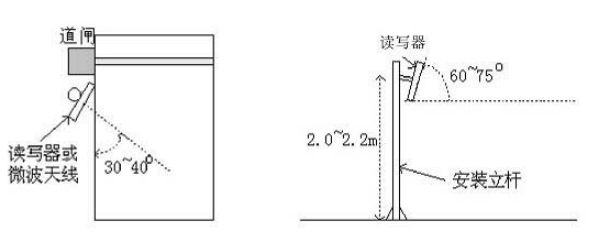
• Antenna angle: the angle of the antenna tilting towards the ground and the horizontal line, approximately 60-75°
Angle azimuth of antenna: the direction of the antenna in the direction of the driveway, approximately 30-40°
Examples of installation — vehicle garage management
• The principles for selecting the location of the ZJ903-9DBI reader system are:
◆ ZJ903-9DBI reader not more than 1 m from the straight line of the gate
◆ No object mask between the location of ZJ903-9DBI readers and the tag card
◆ The distance between the ZJ903-9DBI reader and control equipment (or PC machine) is as close as possible and the physical installation of a specific telecommunications cable using a shield is generally determined on the basis of the situation on the ground ... as described below.
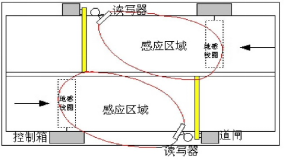
• Site installation mode I: Safe islands with no intermediate separation of roads, road control equipment (gates) installed on both sides of the road and vehicles passing through card reading areas at a speed of less than 30 km/hour.
◆ In this case: the reader (the antenna) is required to be in a position to approach the gate, while at the same time allowing it to read the effective range of labels (with a distance of 0.5-10 m from the line as far as possible) to cover the imported or exported geo-sensor circle at the point of entry, as shown in the figure:
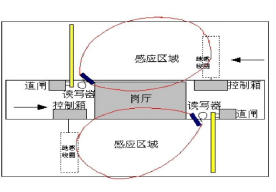
• Site installation mode II: the road has a secure intermediately isolated island, control equipment (barriers) is installed on a safe intermediately separated island with vehicles passing through card areas at speeds of less than 10 km/hour.
◆ In this case: ZJ903-9DBI readers are required to be close to the gate equipment, while allowing them to read labels with a valid range (at a distance of 0.5 m-10 m from the line) that can cover the imported or exported geo-sensor loop at the point of entry, as shown in the figure:
ZJ903-9DBI Secondary development
◆ Users can develop a second set of scripting applications as needed. We provide call routines like C#, VC, VB, Delphi, Java and WINCE, LINUX Drive, for use in the SDK Development Guide.
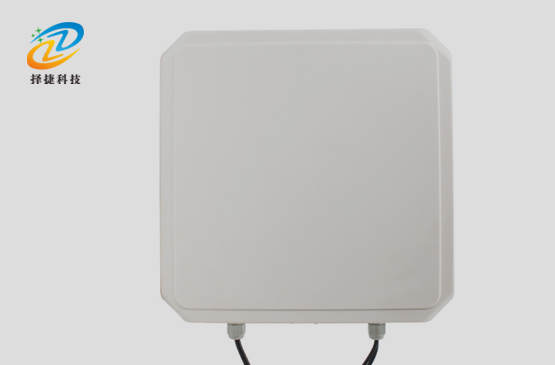
Product Presentation
 Ms. Lei
 Mr. Pang