


AGV Logistics System Integration (Reference Design)
Model: Reference Design
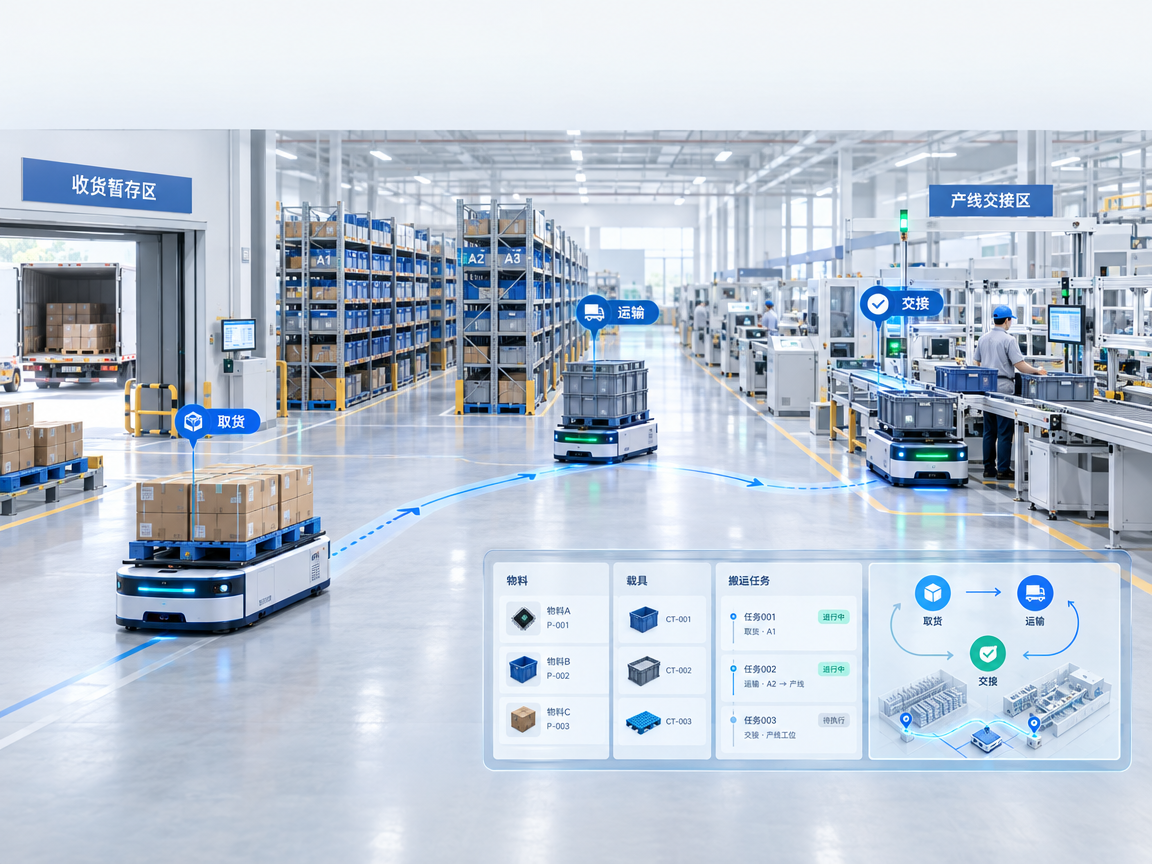
Solution Overview
Connect warehouse transactions and material records to AGV transport from receiving and putaway through lineside delivery and empty-carrier return.
Transport workflows
Turn receiving, dispatch, replenishment, and empty-carrier returns into traceable missions with explicit completion criteria.
Stations and carriers
Manage buffers and handoff stations. Associate the material, pallet or tote, and transport mission.
System Coordination
Coordinate information across WMS, MES, scanning or RFID equipment, and fleet management.
Operational history
Review waiting time, mission duration, congestion, and exceptions to adjust fleet and buffer capacity.
Deployment Workflow
- Verify the material and carrier records.
- Generate a transport request and validate the stations.
- Pick up, move, and hand off the load.
- Report the result and update the business record.
Raw material supply
Link line orders, carriers, and AGV missions across warehouse and production.
Warehouse transfers
Use position confirmation and handoff signals so buffer and transport status stay synchronized.
Implementation and Acceptance
Define which system owns each inventory or transport record. Confirm the carrier standard, load envelope, and buffer capacity. Validate the complete workflow with the actual pallets, loads, and transfer equipment.
This is a reference integration design. Scope, interfaces, deployment size, and performance depend on project requirements. The cover image illustrates an application and does not depict a delivered project.
Specifications
| Business processes | Into, out, patches, back-up, etc., configured according to needs |
|---|---|
| Object Management | Materials, trays, boxes, sites and missions |
| Business interface | WMS, MES, dispatch platform, protocol confirmed. |
| Means of identification | Scanning, RFID or manual confirmation, selected by field |
| Business records | Time-consuming, unusual, waiting to cross over. |
| Acceptance Criteria | Material connection, mission callback, site lock-in to the books. |
Product Features
- Logistics tasks: Converting the in-stock, out-of-house, workstation distribution and empty load recovery to a traceable removal process with mission status and operational completion conditions.
- Sites and carriers: manage caches, hand over workspaces, pallets or box information, and establish links between materials, loads and transport tasks.
- System connectivity: plan data exchange between WMS, MES, Scanning or RFID collection systems and movement control platforms to reduce manual re-entry.
- Operational analysis: consolidate the waiting time, task time, site congestion and unusual records to provide a basis for vehicle replenishment, adjusting the beats and setting up the cache.
 Ms. Lei
 Mr. Pang