


AGV Fleet Management System (Reference Design)
Model: Reference Design
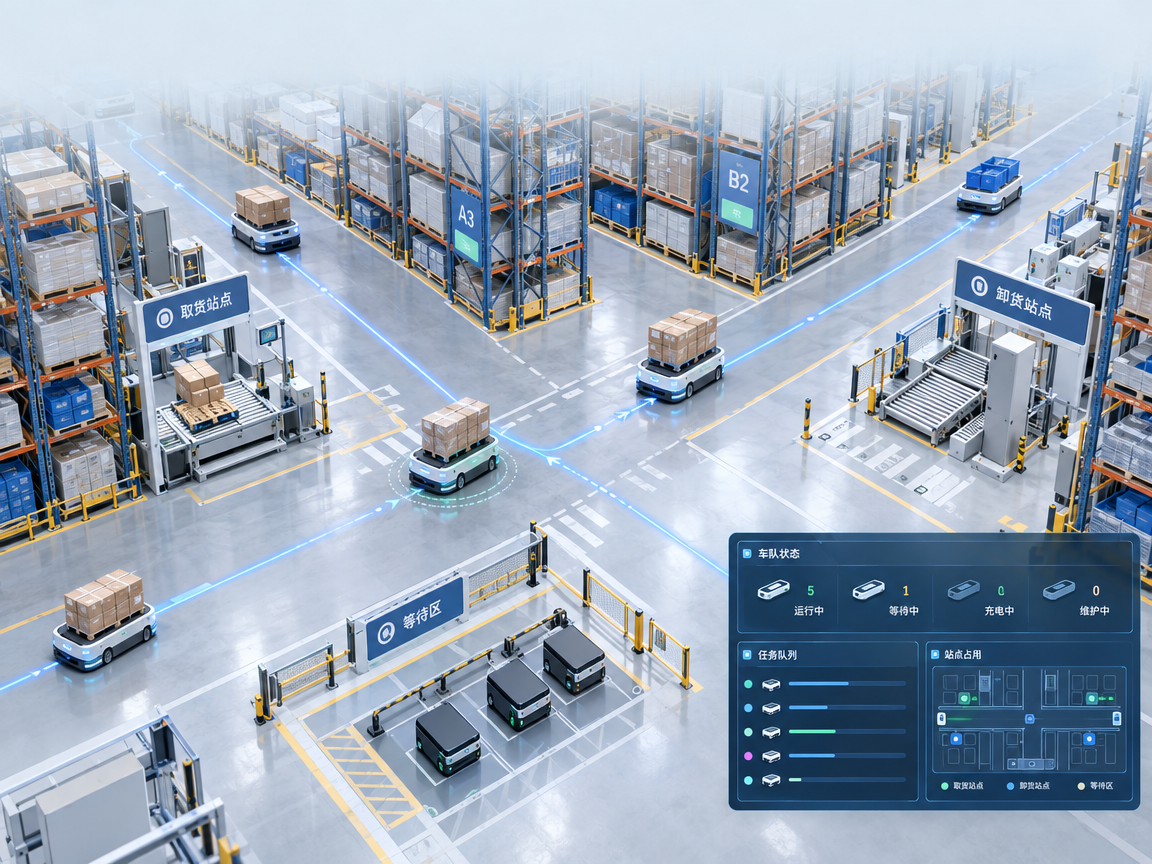
Solution Overview
Convert warehouse and production transport requests into AGV missions. Assign vehicles, coordinate shared areas, and track each mission through completion or exception handling.
Mission planning
Set pickup and delivery points, priority, and completion criteria for operator calls, recurring transfers, and business-system requests.
Fleet assignment
Select available AGVs by vehicle type, payload, online state, battery level, and current mission. Allow authorized operator intervention.
Traffic coordination
Set access rules, waiting points, and zone reservations for intersections, narrow aisles, and shared stations.
Exception recovery
Record failed missions, prolonged waits, and offline vehicles. Define pause, reassignment, and manual takeover procedures and retain the results.
Deployment Workflow
- Create a transport request.
- Validate the stations and select a vehicle.
- Reserve travel segments and move the load.
- Report status and close or reconcile the mission.
Receiving and dispatch
Prioritize competing transport missions and track pickup, travel, and unloading.
Lineside replenishment
Submit workstation requests to the fleet manager so available vehicles can be assigned as calls arrive.
Implementation and Acceptance
Confirm the vehicle interfaces, fleet size, peak mission volume, site map, aisle widths, and fire safety requirements. Multi-brand support depends on the interfaces each vehicle exposes. Keep vehicle protective functions in operation alongside traffic coordination.
This is a reference integration design. Scope, interfaces, deployment size, and performance depend on project requirements. The cover image illustrates an application and does not depict a delivered project.
Specifications
| Source of mandate | Manual creation, site calls, business interface, by project configuration |
|---|---|
| Manage Object | AGV vehicles, missions, stations, pass areas |
| Operational interface | WMS, MES or other supersystems, interface to be confirmed |
| Run Policy | Priority, vehicle suitability, traffic rules, charging strategy |
| Deployment pattern | Local server or project specified environment |
| Acceptance Criteria | Mission closed loop, sector occupancy, failure recovery and log tracking |
Product Features
- Tasking: Sets the pick-up point, delivery point, task priority and completion conditions, handles manual callage, time handling and movement requirements triggered by the operational system.
- Vehicle fleet distribution: Matching of available vehicles for tasks to be performed, with manual access to the vehicle type, load capacity, online status, remaining power and current tasks.
- Transport coordination: Establish rules of passage for intersections, narrow access and shared workspaces, and deploy waiting points and sector occupancy mechanisms to reduce conflicts caused by multiple vehicles entering restricted areas simultaneously.
- Unusual recovery: recording of mission failure, long waiting periods, offline equipment etc., planning for suspension, re-dispatch and manual takeover processes, and maintenance of records of unusual disposals.
 Ms. Lei
 Mr. Pang